 |
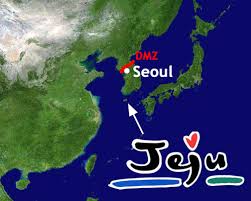
| Not my photo! Duh. |
Turquoise seas embroidered by golden beaches. Fences of black basalt rock surrounding small fields of vibrant rice and tea fields. Small towns, scenic walks, fairy waterfalls and hidden pools. Towering volcanic domes, dizzying craters, dazzling views of the ocean. Welcome to Jeju-do.
 |
| Basalt rocks make convenient fencing on this volcanic island. |
I arrived in Jeju Island on the last days of my Korean visa, having just completed my year of teaching near Gayasan National Park. The whole year, everyone who spoke to me recommended Jeju as the "Hawaii of Korea." One of the
New7Wonders of Nature, the whole island is a tourist trap, but one I was definitely willing to indulge in for four days.
You can fly there, but I recommend taking the ferry from Mokpo on the West Coast. It only takes a couple hours and, if you have a strong stomach, is a really fun ride bouncing on the waves. Beware, some of your fellow passengers may upchuck.
Knowing me, the first stop wasn't the beach. It was *drum roll*
Hallasan - the volcanic creator of Jeju-do. At 6,398 feet, it's the highest mountain in Korea, and thus vital to my bucket list. Hallasan is a shield volcano, its last eruption in 1007. There are a ton of hikes, but only two hit up the summit.
 |
| The steepest portion of the hike, coming up! |
 |
| View from near the top looking north. |
I hitched a ride to the mountain (first attempt! Par 1!)** and went up the Gwaneumsa Trail on the North Side, which had a gentle climb. The forest is verdant and there are quite a few interesting sea views, with cliffs and a cave or two. At the summit, the volcanic crater looms large beneath your feet, with Baeknok Lake giving it a must-photograph status. Don't judge it based on my poor photography skills!
 |
| Baeknok Lake and the crater! |
Heading downhill via the Seongpanak Trail was an easy walk, with the usual nice paths, accessible stairs, and crowded with tourists. This is the only easily accessible by bus trail to the top, so it's crowded.
The next day saw me heading to the southern part of Jeju-do near Seogwipo, where I hit up a tremendous amount of incredible waterfalls. The Cheongjeyeon Falls, a three-tiered waterfall, has a lovely legend associated with it. Cheongjeyeon means Pool of the Emperor of Heaven (or something like that) and at night seven fairies would descend from heaven to bath in its waters. If you stand under the waterfall on the 15th day of the 7th lunar month, your diseases will be cured! Of course, swimming is now prohibited, so there's no way to test it. The scene does have an aura of magic. I recommend hitting up the nearby botanical garden as well.
 |
| Cheongjeyeon Falls, the second tier, taken from the bridge. |
 |
| The Pool of the Emperor of Heaven, can you imagine the seven fairies? |
 |
| Interesting little cavelet at the pool. |
 |
| The seven fairies descending from heaven, a painting in the nearby pavilion. |
The next stop really peaked my geological interest. Jusangjeolli is a rocky shoreline, but with such interesting features! As the molten lava reached the sea, it cooled into hexagonal shapes, creating this spectacular formation.
 |
| The hexagonal stones were constantly being bashed by ocean waves. |
 |
| A truly fascinating geological puzzle! |
Then I hit up Cheonjiyeon and Jeongbang Falls. Jeongbang is the only waterfall in Asia that falls directly into the ocean, but this technically disputed due to its falling into a sheltered cove. In my opinion, it's 10 feet from the sea, so I'll give it to them. :P
 |
| Cheonjiyeon Falls |
 |
| Jeongbang Falls, falling into a pool, right on the beach. |
I headed to the eastern coast of Jeju-do towards the Sunrise Peak in order to be in position for a highly lauded pre-sunrise climb. Seongsan Ichulbong (sunrise peak), is a tuff cone that looks from a distance like a monstrous massive castle perched on the edge of the sea. I woke up a good hour and a half before dawn and climbed in the dark. The day brightened, but due to cloud cover the sunrise escaped my lens. Still, the crater is cool, the hike up pleasant, and the crowds minimal. Head down to the beach to check out the Haenyo - women divers - who put on an exhibition. I went to the museum in Gujwa, definitely worth a look. The haenyo were the breadwinners of the family, contrary to traditional Confucian ways. They can hold their breath for more than two minutes and dive to more than 20 meters, harvesting conch and abalone for good money.
 |
| Seongsan Ichulbong in the distance. |
 |
| My faithful companion Charley, posing in front of the Sunrise Peak. Next to it are the traditional statues of Jeju. |
Next stop: the lava tube caves,
the must-see of Jeju-do. Lava tube caves are created during an eruption when the low-viscosity lava flows underneath the surface. The outer lava cools, creating a shell and as the lava levels drop, empties out to form a long, tube-like cave. Jeju-do has the honor of having some of the biggest lava tube caves in the world, and
Manjanggul is the zenith. 7,000 meters in length, and 23 meters tall in many places, this cave is enormous. It is scientifically precious due to its age (200,000 ~ 300,000 years old) and preservation. Anyway, stepping inside the air is cool, the cave feels like a cathedral, the walls black with ancient lava flow lines marking the walls like a kid measuring his height. Manjanggul is home to the largest lava column in the world, at 7.6 meters. The cave system is well-deserved of its UNESCO World Heritage status.
 |
| The largest lava column in the world. |
The last thing I did in Jeju-do was check out the Planetarium. It was AWESOME! But hey, I'm a nerd, what can you do? :)
 |
| A beautiful tea farm. |
 |
| In the botanical garden. |
 |
| Caves are numerous and ominous! |


No comments:
Post a Comment