All roads in Cambodia are bumpy, but getting the brains shaken out
of you is no deterrent for the awesomeness that is Angkor Wat. The
largest religious temple in the world, it is a city of temples
devoted to Hindu gods and Buddha. It was built by the Khmer empire in the
12th century, forgotten, then "rediscovered"* by the French
during their ruling of Indochina in the 19th century.
 |
| Roar! |
These jungle-covered monuments must have inspired such awe and
fascination for the French explorers. Think of it: sweating for endless days through the jungle, when suddenly, a giant stone face, covered
in vines and roots of enormous trees, appears. This is the stuff of
Indiana Jones and Tomb Raider. To find such monolithic treasure, can
you imagine?
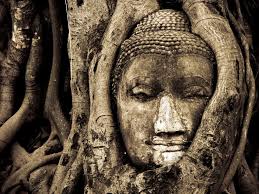 |
| Buddha Buddha Buddha Buddha Rockin' Everywhere! |
My sister and I hired a tuk-tuk and a guide to show us the sites.
Believe me, it is well worth the cost of a guide; the history behind
Angkor Wat is mesmerizing to learn about. Unfortunately, you have to
wake up before dawn, because A. You get to see the big temple at
dawn, and B. It is waaaay too hot by 10 am. Warning: this can entail
many days of exploring, but you can get to all the best parts in two
days. So get the three day pass, after three days, you'll be templed
out. :)
The biggest building is what everyone refers to as Angkor Wat; it
is the main temple, the biggest and most impressive. You walk across
a great moat on a stone pathway protected by lions. Then it appears,
surrounded by trees that would dwarf any other building, with a most
picturesque lake in the front. At dawn it looks sullen yet
magisterial, as the day grows brighter, your eyes pick out the
fantastic details - from the scalloped roofs to the crenelated walls.
 |
| The main temple of Angkor Wat at dawn. |
 |
| My sister and the guide. |
Our guide, who reeked of whiskey, was actually quite eloquent and
could speak very good English. I've always had a fascination for Asian
religions and philosophies, and seeing the
Ramayana and
Mahabharata carved in delightful bas-relief was truly engrossing and charming. The bas-relief
The Churning of the Sea of Milk and the battle scenes were detailed and made with love as only a master carver can.
 |
| Nom nom nom |
 |
| Avast ye! |
Climbing
up the towers, Buddha comes more to the fore, with many statues giving
the place a sense of serenity. Even with the heat and multitudes of
tourists, peace and buzzing of insects predominates - that's how
enormous this temple is.
 |
| View from up the staircase. |
 |
| Checking out a tower |
 |
| Traditional Cambodian dancers. |
After a good long tour of the
main temple, we headed to the Bayon temple. This one is extremely
picturesque, if it weren't for the hordes of tourists at every corner.
Still, it has its charm, with narrow lanes and stairwells, giant buddha
heads smiling everywhere, and steep, dark towers. This has been
described as Khmer baroque style, while the main temple Angkor Wat is
classical style. Bayon is set in Angkor Thom, the last capital of the
Khmer empire.
 |
| Count the buddhas! There are four! |
Then we went to what is known as the
"Tomb Raider" temple. It's real name is Ta Phrom, and it has been left
in partial ruin - so tourists can enjoy feeling the experiences of the
white colonialist/fake archeologist**. Seeing the rubber and Banyan
trees swallowing (to its integral detriment) the ancient structure
provoked amazement and inspired the must-photograph-at-every-angle
feeling. The alluring aura of mystery and orientalism abounded.
 |
| Me and a banyan at Ta Phrom |
 |
| The Tomb Raider entrance, swarmed. |
Unfortunately,
it was completely packed, more so than the Bayon temple. And leaving -
you get attacked by hordes of beggar children trying to sell plastic
crap from China. They kept repeating "Twoo fo' one dollah" in unison and
canon, that at times it sounded like a well-rehearsed song. There are
many orphans and poor children in Cambodia and it hurts to see them. No
wonder Angelina Jolie adopted one.
The next day, we
continued our tour of the temples farther afield. I'll just focus on
Bantay Srei, because it still stands out in my mind. Since it's far from
the main drag, there were about three tourists there. The quiet and
heat make you walk slow, taking in every agonizingly beautiful detail.
It was made in the 10th century and is on a much smaller scale than the
ones we visited previously. It's made of red sandstone, which gives it a
delightful pink hue. This stone is easily carved, allowing for
intricate, detailed designs. The decorations and motifs force you to get
close to truly admire the artwork. This was my favorite temple.
 |
| Bantay Srei |
 |
| Amazing detail |
 |
| Go Shiva, go Shiva! |
*The locals knew about it, just like the locals in Machu Picchu knew about
their ancient city.
**Tomb Raider, Indiana Jones.


No comments:
Post a Comment